Cum on Feel the Noize
by Jamie Allen
Published at continent. 2.1 (2012): 56–58
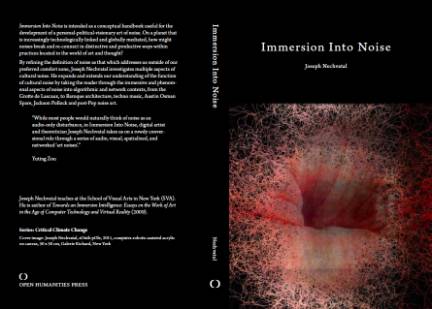
Nechvatal,
Joseph, Immersion Into Noise, Open Humanities Press, 2011, 267 pp, $23.99 (pbk), ISBN
1-60785-241-1.
As someone who’s knowledge
of “art” mostly began with the domestic (Western) and Japanese punk and noise
scenes of the late 80’s and early 90’s, practices and theories of noise fall
rather close to my heart. It is peeking into the esoteric enclaves of weird
music and noise that helped me understand what I think I might like art to be:
A way of learning about the world through perturbation—exploration by
incitement and speculation of possible conditions. What I have always loved
about artistic investigations influenced by noisy aesthetics or sensibilities
is that they can be simultaneously transcendent and absurd, amusing and
revelatory, singular and pluralistic, mindless and intensely penetrating. The
provocative friction that noise brings to bear on aesthetic experience,
artistic practice, and “the” Art World acts as a kind of impulse response,
proposing new energies while revealing underlying structure; noise signals are
a simultaneous synthesis and analysis of spaces, subjects and relations.
About two weeks prior to
Christmas 2011, Joseph Nechvatal was generous enough to spend some time with me
at 39 Quai des Grands Augustins, Paris. We each
had one glass of red wine, briefly discussed common acquaintances, shared
points of interest, and his published writings. We also, I recall, disagreed
lightheartedly about how much contemporary relevance the ideas of
telematic-artist Roy Ascott have for today’s art-and-technology practitioner
(Joseph > Jamie). After the encounter, I read through a PDF version of Immersion
Into Noise Joseph was kind enough to send me (the HTML version is here).
A number of points of entry
into cultures of “noise” are available these days. There are the acoustic-spatial
approaches of thinkers like Douglas Kahn, Brandon LaBelle and Salome Voegelin;
the techno-cultural musicologies of Jonathan Sterne and David Toop; the
political writings of Jacques Attali, former adviser to President François
Mitterrand, in his Noise: The Political Economy of Music (spoiler
alert: It’s not really about music). Enter the new writings of one Joseph
Nechvatal, with his invitation of an Immersion Into Noise.
Nechvatal has been active
for over 20 years in on- and off-line discussions of art, technology,
virtuality, as well as his own set of art-theoretical departures and
terminologies. A practicing artist, and instructor at the School of Visual Arts in New York City, Immersion
Into Noise, is Nechvatal’s third published volume. His writings, broadly,
address a concern with the possibilities of a synthesis between the biological
and the virtual, and the contemporary artistic resonances that these
possibilities suggest. Nechvatal’s project is to try to name contemporary
currents of artistic practice within our technologized culture. He comes at
this through art history, post-modern philosophy, anthropology and
consciousness studies. Portions of Immersion Into Noise have
appeared in his PhD dissertation, as well as online art publications like Zing Magazine. An
open-access publication, and part of the impressive and heartening activities
of the Open Humanities Press, Nechvatal’s book is a somewhat unexpected
addition to the Critical Climate Change series edited by Tom Cohen of SUNY
University and Claire Colebrook of Penn State. Other titles in the series have
address themes of post-globalism and cultures of threat. Joseph Nachvetal’s
title is the first to focus entirely on art history, art practice and
aesthetics.
It is awkward to too easily
fit Nechvatal’s writings in with the aforementioned burgeoning canon of
cultural and artistic practice in, and writings on, noise (Russolo, Schaeffer,
Cage and Yves Klein through to Kahn, LaBelle, Voegelin, et. al). Immersion
Into Noise is not primarily an examination of sound-noise or
phenomenologies of sound, and the relativist, non-objectivist possibilities
arising therefrom in social, public, and exhibition art practices. Although
Nechvatal makes mention of sonic practice and experience (his own encounter in
1968 with the technological complex was set in motion at a Jimi Hendrix concert
at the Chicago Coliseum), he does so only by way of introducing a broader
concept of “art-noise.” The noise-scape can envelope various kinds of
involvement in all kinds of art, by artists, audiences, and distributed
amalgams of all of these. Midway through the book, we are offered
characteristics of an “immersive noise vision theory.” This theory, leading to
an even more syncretic thinking about the art experience, is sketched out
through further reference to the author’s personal observation, as well as his
art-historical research and notes. Personal examples take on the reflex of a
kind of art-noise-travel-writing, as Nechvatal visits Ryoji Ikeda’s Datamatics
[ver 2.0] installation at the Centre Pompidou, Paris), hears Cecil Taylor
at Alice Tully Hall in New York, spends time with the cave paintings of Lascaux,
France, and explores the Wagner-inspired Venus Grotto of Linderhof, Bavaria, to
name a few. These site-events, to varying degrees, are renderings of
noise-art’s potential to “place us back into a ritual position by dragging art
down into the felt 360° noise-perspective of the enthusiastic and
participatory.” (p.103)
The arc of the ideas
proposed here position immersiveness, saturation and “scopic all-over tension”
as most productively foundational to noise art, or art-noise. An itinerary from
the most ancient of artistic expressions (cave drawings) to the most digital of
presentations is charted (Ikeda’s minimal/maximal bitwise works for
synchronized audio and visual projection). The harsh sonic onslaught of Masami
Akita (a.k.a. Merzbow), is, under this analysis, not so far from colossal
denseness of the churches of the High Baroque (Nechvatal visits the Rosario
Chapel in Santo Domingo Church, Puebla, Mexico). And there is much more here,
eaten up by noise: A rethinking of the work of Duchamp, Jackson Pollock,
Nicolas Schöffler (whom Nechvatal names the true “the Father of Cybernetic
Art”) and the Happenings of Alan Kaprow, all as art-noise in their own right.
Each of these artists and moments demonstrate techniques of destabilization,
immersiveness, frame-breaking and “all-over fullness and fervor.”
Here is writing on art and
art history that is as ambitious as it is promising: “wildly visionary,”
Nechvatal states as in conclusion. Self-admittedly far-reaching to the point of
verging on totalization, we are asked to consider that the moments, spaces,
arts and artists Nechvatal appreciates in the book all derive from an
increasingly prevalent “noise consciousness.” Along the way we gain an
appreciation of noise as a productive and proactive tension in art, rather than
an unwanted signal or unwelcome intrusion. Most promising here for me are
Nechvatal’s revealing descriptions of the potential for noise to make manifest
the material-perceptual framework of individual and collective art experience.
How might we allow what we have been repeatedly taught is our contemporary
condition of “information overload” to transform itself into a calm, warm,
sympathetic kind of inundation. Treatment of experience in this way, dissolves
boundaries between the bodily, informational, material and technical complexes
that make up our world, and is the promise of a radical, if momentary, Immersion
Into Noise.
- Jamie Allen
Published
at continent. 2.1
(2012): 56–58
http://continentcontinent.cc/index.php/continent/article/viewArticle/76
References
Nechvatal,
Joseph. Immersion Into Noise. Open Humanities Press. 2011.
Immersion Into Noise
[Paperback] by Joseph Nechvatal is now available for purchase here: http://www.amazon.com/Immersion-Into-Noise-Joseph-Nechvatal/dp/1607852411
and at Amazon worldwide